
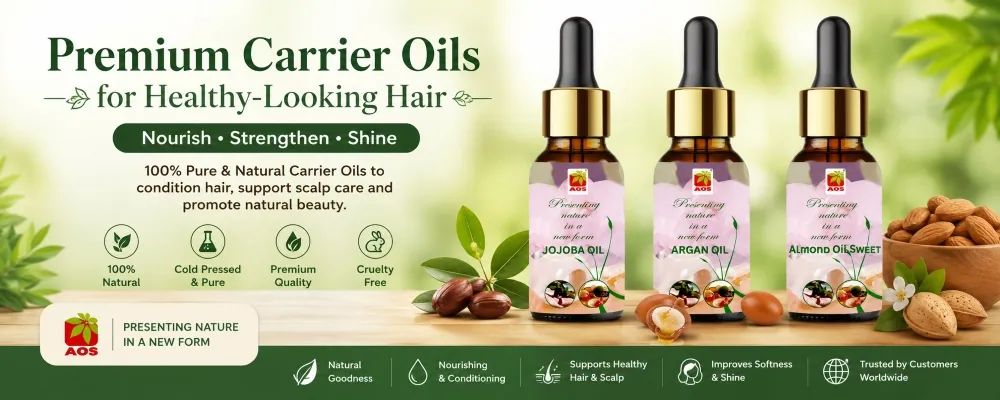
7 Best Carrier Oils for Hair Care: Natural Oils for Healthy-Looking Hair
Carrier oils have been part of natural hair-care routines for generations. Carrier oils can make a simple hair-care routine more nourishing and versatile. Depending on the oil selected, they may help:
- Condition dry-looking hair
- Improve softness and manageability
- Reduce the feeling of roughness
- Support a relaxing scalp massage
- Create customized hair-oil blends
- Dilute concentrated essential oils for topical use
The key is choosing an oil according to your hair type, preferred texture, and routine.
7 Best Carrier Oils for Hair:
1. Jojoba Oil
Jojoba Oil has a naturally lightweight texture and spreads easily across the scalp and hair. It is a popular choice for people who prefer a non-heavy oiling routine.
Best for: Lightweight scalp and hair conditioning.
2. Argan Oil
Argan Oil is valued for its smooth texture and naturally occurring fatty acids. It can help make dry-looking hair feel softer and more manageable.
Best for: Dry, rough and frizz-prone hair.
3. Sweet Almond Oil
Sweet Almond Oil is a versatile carrier oil commonly used in massage and personal-care formulations. Its smooth texture makes it suitable for regular hair-oiling routines.
Best for: Everyday hair and scalp care.
4. Castor Oil
Castor Oil is naturally thick and rich compared with many other carrier oils. For easier application, it can be combined with a lighter oil such as Jojoba or Grapeseed Oil.
Best for: Rich conditioning blends.
5. Grapeseed Oil
Grapeseed Oil has a lightweight consistency and is a good option for people who dislike a heavy feeling after oiling.
Best for: Fine hair and lightweight formulations.
6. Avocado Oil
Avocado Oil has a richer texture and works well in nourishing hair-care blends. It can be particularly useful for dry or coarse-feeling hair.
Best for: Dry and coarse hair.
7. Coconut Oil
Coconut Oil remains a popular choice for traditional pre-wash hair-oiling routines. It can be used alone or combined with other carrier oils.
Best for: Pre-wash oiling and conditioning routines.
How to Use Carrier Oils?
For a simple pre-wash routine:
- Select a carrier oil suitable for your hair type.
- Take a small amount and gently massage it onto the scalp.
- Spread the remaining oil through the lengths of the hair.
- Leave it for a suitable period according to your routine.
- Wash thoroughly with a mild shampoo.
Avoid using excessive amounts. More oil does not necessarily mean better results.
Carrier Oil + Essential Oil Blending Guide:
Carrier oils are particularly useful when working with essential oils because essential oils are highly concentrated and should generally not be applied directly to the skin.
For a simple starting blend, use 1 tablespoon (15 ml) of carrier oil with approximately 2–3 drops of essential oil.
Popular combinations include:
- Jojoba + Rosemary Essential Oil – lightweight scalp-care blend
- Coconut + Peppermint Essential Oil – refreshing hair-care blend
- Sweet Almond + Lavender Essential Oil – soothing aromatic routine
- Grapeseed + Tea Tree Essential Oil – lightweight scalp-care blend
Always follow the essential oil manufacturer's recommended dilution and safety instructions.
Common Mistakes to Avoid:-
Using too much oil: Heavy application can make washing difficult and leave hair feeling greasy.
Applying essential oils undiluted: Essential oils should be properly diluted before topical use.
Choosing an oil without considering hair texture: A rich oil may feel uncomfortable on fine or oily-feeling hair.
Ignoring patch testing: Test a small amount of your blend before regular use.
Expecting instant results: Natural hair care works best as part of a consistent routine rather than a one-time treatment.
Check FAQs:
Can carrier oils be used directly on hair?
Yes. Many carrier oils can be used directly as part of a hair-oiling or conditioning routine. Always follow the specific product's usage instructions.
Which carrier oil is best for oily hair?
Lightweight options such as Jojoba Oil and Grapeseed Oil may be preferable for people who dislike heavy oils.
Can I mix different carrier oils?
Yes. Combining carrier oils can help you create a blend with the texture and characteristics you prefer.
Any Commercial Inquiry: Click Here
